"But I Don't Want to Kill Anyone!"
I was recently reading an article on self-defense in which the author was speaking of violence as if you could pick and choose the level of seriousness of the interaction, i.e., if he just wants to 'kick your ass' you kick his ass back, not *really* hurting him, but teaching him a lesson. If he's a little more serious, then so are you -- and if he wants to kill you, well, that's the only time you're going to use certain techniques and targets like eyes, throat and so on. "It's the idea that you can choose to hit someone with, say, 60% of what you've got -- and that you'll only ever hit someone with 100% when your life depends on it."
This idea illustrates a fantasy disconnect between 'fighting' and violence, one that deserves a fantasy name: I often refer to this idea as 'dialing in your Spidey-power.' (With many apologies to Stan Lee.) It's the idea that you can choose to hit someone with, say, 60% of what you've got -- and that you'll only ever hit someone with 100% when your life depends on it. It's being able to look at an impending 'fight' and say 'well, he's not really serious, so I'll dial my Spidey-power down to 50%' and then sock him hard, but not TOO hard, because, after all, you don't want to kill him, right? Here's the problem: holding back can get YOU killed. There are many ways to hold back:- You can wait and see to try and suss out what his intentions are,
- You can make certain targets 'off limits' because wrecking them is awful (you'll never hear me say otherwise) -- like the eyes or breaking a knee, both permanent, crippling disabilities, and/or
- You can 'go easy' on him by not striking as hard as you can.
Any one of these leads directly to reduced effectiveness, poor results, and in the worst case, can get you killed.
The idea that you can suss out his intentions is a fantastical delusion. If you don't have psychic powers (and my guess is... wait for it... you don't) or can know the evil that lurks in the hearts of men like the Shadow does, then you're screwed. You'll know he wants to kill you because, well, he's doing it. That is not the time to find out. In fact, it's never a good time to find out, right?
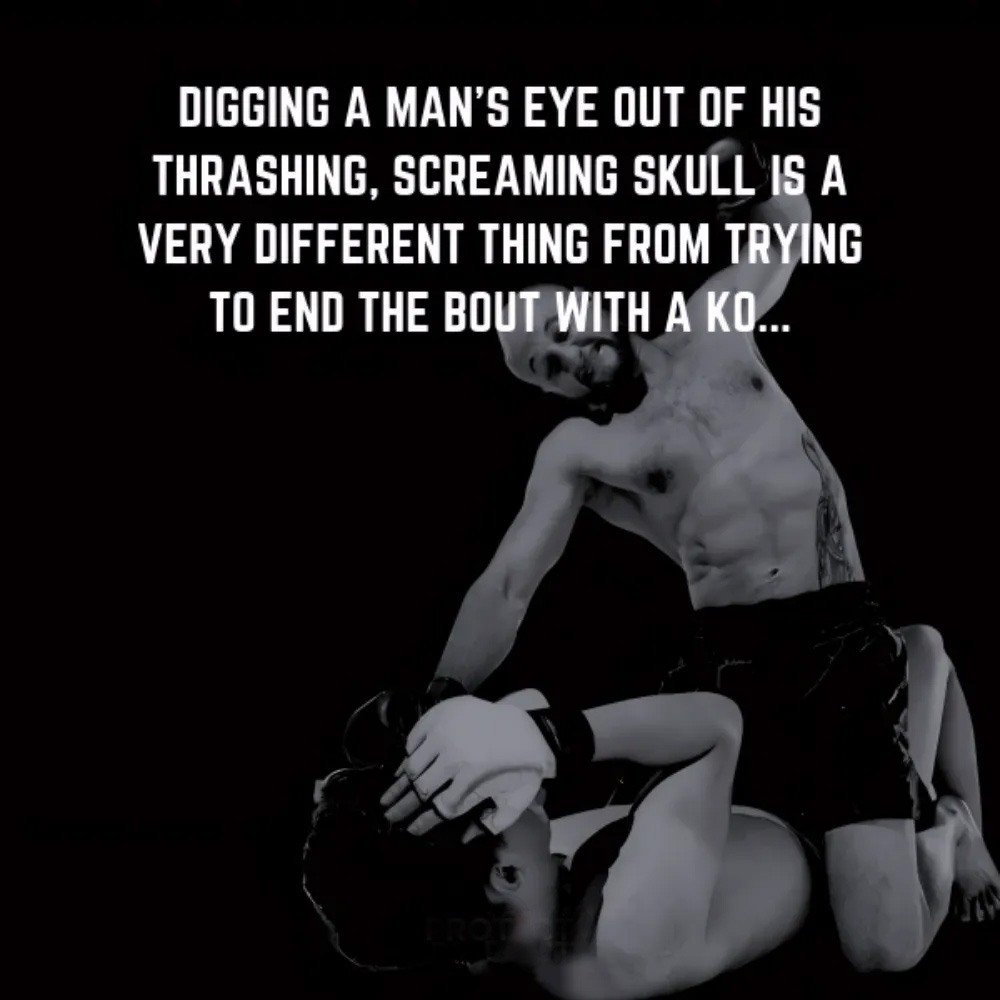
Making targets off limits ahead of time ("I'll never take the eyes") will give you a hesitating hiccup if your next -- and only -- opportunity is that target. You will stop. And try to get restarted. If you're lucky, it means nothing. If you're unlucky, the opportunity is gone and you just got shot/stabbed/whatever (perhaps again) and you just better hope he got it wrong.
You always want to strike the man as hard as you can. Always -- as hard as you can. 'Holding back' reduces the chance of injury. Now we're into the realm of slapping each other around, pissing people off, and delivering non-specific 'light' trauma that is neither a persistent injury nor spinal reflex inducing. It's wasted motion that let's him know it's on.
The author did believe, however, that in a real worst-case scenario a magical transformation would occur -- that even though you'd been neutering and watering-down your training by waiting, making targets off-limits and slapping at them you could suddenly rise to the occasion of your impending murder by crushing the throat or tearing out an eye with full force and effort.
That's a neat idea, but it flies in the face of 'you do what you train.'
So, to that point, how does the way we train serve you? It would seem, on the surface, that we ONLY train for the worst-case scenario, that to use what you know in any other situation would be like using dynamite as a can opener.
Let's put it this way: the 'worst-case scenario' encompasses and includes all other possible scenarios; going in purely to cause serious injury, put the man down and then pile it on (i.e., start kicking a 'helpless' man on the ground) covers, handles and takes care of anything and everything he may have or have wanted to do to you.
But the real beauty is that you can stop at any time.
You'll typically do this the moment you recognize that he's non-functional.
Let's say you start out by breaking his jaw at the TMJ. You get the minimum expected reaction -- he turns slightly, somehow keeps his feet. You come back with a shot to the groin and get a HUGE reaction, he goes down face-first and tries to curl up in a fetal position. You break his ribs and then strike to the side of his neck, knocking him unconscious. At this point you recognize that he is non-functional (to your satisfaction) and stop.
(Notice that I didn't mention any techniques or tools -- that's because they don't matter. Injuries matter.)
This sequence could have been different at each node of injury -- you break his jaw and he spins around three times and lays down, out cold; you stop when he goes fetal after the groin strike; you stop after breaking the ribs because as far as you're concerned, your read on him is 'done.'
You also know how to carry it to a more final conclusion with a stomp to the neck, a neck break, a stomp to the throat, etc. But always as an informed choice -- not out of desperation, and not after having been trained that it is 'wrong' or morally less-than.
You also know how to start right off with throat-eyes-neck break, but again, as a conscious choice. If killing is what will see you through, you will kill him. If killing is not appropriate, you can still operate because you know where the line is. All violence is the same
This is because you are trained in the totality of violence, understanding it for what it is -- a single-use tool that does not have an intensity dial on it. You can't make guns shoot 'nice.' And what a bullet does is the purest expression of everything we're ever talking about. All violence is the same.
So what does this mean for you?
First and foremost it means you understand that violence is not a plaything -- you won't goof off with it any more than you would with a loaded firearm. This is healthy. It means you won't get sucked into stupid shenanigans (antisocial) thinking you can use what you know without any negative repercussions. It means you're going to be smarter about when to pull it out and use it. This is going to save you tons of wear and tear, not to mention legal troubles.
It means that when you do use it, you're going to use it the only way you can be sure it works -- with no artificial social governors restricting what you can and can't do. You'll strike him as hard as you can to cause injury. And you'll take full advantage of that injury, replicating it into non-functionality.
If we view this through a social lens it is savage, brutal, dirty, unfair and very probably illegal somewhere. This was the essential thesis of the self-defense author.
But the question you have to ask yourself is are you going to bet your life the other guy is playing by the rules?
If he is, well, then you're a jerk, aren't you?
If he isn't, you're dead.
The moral of the story is: screw around with violence the same way you'd screw around with a firearm -- don't. Labels: fighting, intent, Intimidation, lethal force self defense, self defense
www.targetfocustraining.com
All content including text and images
Copyright ©2008 by The TFT Group. All rights reserved. |
|
|
Owning Violence: How to Look More Like You
 A common question we get from clients is, "How can I learn to move like you?"
The answer is, "You can't."
Now, this isn't a haughty, ego-driven response. It's the truth -- the only person you're truly going to move like is you.
And that's the key to owning violence -- figuring out how you, with your idiosyncrasies, can best get the job done.
I realize that's all very nice to say, but what can you do to get there?
Hew to base principles. Every act of violence is unique -- that is, no two start the same, progress the same, or finish the same. This fact makes violence look like a big knot of chaos. But inside that knot are the common threads that make up every possible snarl. Intent, penetration, rotation, injury, cause and effect. Know what these are -- study them in order to turn them from abstract concepts into concrete choices and physical action. When you look behind the curtain, this is really all we are ever doing. Make sure you got them down cold and can give a physical, 'real-world' example of each one.
Look at what has to be done, not how it's done. This is the main reason techniques blow. When people see a technique, they immediately concentrate on the method, losing the results somewhere along the way. But a technique, really, is just a single solution to a single problem posited by a single person. It's not universal -- only the principles that underlie it are.
What you want is to 'use your mind to unlock a problem in violence with the key of your body.' This is terribly subjective, and gets us back to the idea that violent acts are like snowflakes (while no two are alike they're all made from the same stuff). If no two violent acts are alike, then you're on your own. You're going to have to rely on yourself to solve every violent act you're ever going to be involved in -- because not only will I not be there to help you, but by definition I've never experienced exactly what you're about to go through.
If it's all up to you and all on you, then none of my personal favorite solutions will make any difference for you at all.
Keep an eye firmly on the results you want and then plow a path from where you are now to where you want to be. This makes it yours. Our results are universal -- injury -- and so the finish line looks the same every time. But how you get there will be all about you. You'll start in a unique place, and you'll get across that line of final injury in your own inimitable way. You'll derive the perfect solution on the fly.
Make it work for you. This is about how you train. When you're getting floor time with a reaction partner, look at what you want and then make it happen. If you think 'I want to throw him down on the ground from here,' then figure out a way to make it so. Perhaps you can stomp on his knee. Or step in and strike him to the side of the neck and then hip throw him. Or strike the neck while you buckle his leg to drop him. The idea is not to get stuck on doing a specific, huge hip throw, but rather to injure by way of throwing.
This makes your training generic and takes the focus off of 'doing techniques' and puts it rightly and squarely on problem solving.
This is really the gist of this entire rant:
In order to look more like you, practice solving problems, not 'doing techniques.'
In other words, this is a really long-winded way of saying 'as you practice so shall you perform.'
Being good at the skill of violence doesn't mean emulating anyone; when you're good at violence it means your mind is good at applying the tool of your body against the problem of violence. In a generic and far-reaching sense. Labels: self-defense training, technique
www.targetfocustraining.com
All content including text and images
Copyright ©2008 by The TFT Group. All rights reserved. |
|
|
The Beating, the Breaking, or the Fall from a Great Height?
The intelligent use of violence involves every means available -- all bets are off and no holds barred. You literally do whatever you want to the man (this is, after all, what we mean by 'free' in 'free fighting'). We have the ages-old rock to the head; we can break his joints by putting the torque in Torquemada; we can use the happy constancy of gravity and other assorted physical laws to line up the ultimate rock to the head, by throwing him into the regolithic embrace of Mother Earth. But which one is better? Which one is a more intelligent use? Is there veracity to the implied hierarchy of striking, joint breaking and throwing? The answer to all of those questions lies in the definition of injury in violence: body weight in motion applied through a target. We all know that injury is the only thing that means anything in violence, it is where violence begins and simultaneously ends, it is the ultimate goal. We also know that striking, joint breaking and throwing all result in injury when done correctly. What most people don't realize is that these three seemingly disparate 'techniques' for causing injury are really all one in the same -- they are three different expressions of the same idea. Striking is easy enough for people to grok; body weight in motion through a target, the rock to the head. Or, to 'fancify' it, the fist through the ribs, the stomp to the throat. Every human being has an innate understanding of this, whether they know it or not. Add a stick or a knife to the outer end of this and we have what looks like choreography for the six o'clock news. Everybody, everywhere, is doing it! Joint breaking is where almost everyone gets left behind. It puts the 'fancy' in 'fancy pants.' Now you must possess the wileyness of the monkey, the speed of the cheetah and the suppleness of the cockroach, right? Probably not, given that an excellent joint break can occur 'accidentally' in an American football game from nothing more advanced than one guy falling on another. Throwing is even more 'advanced' than joint breaking, right? I mean, it's last on the list, and who really has the inhuman strength to pick up and hurl a 300 pound screaming man to the deck? Well, very few people, if you put it in those terms. If we change those terms, say to defining a throw as an uncontrolled fall into the ground (uncontrolled for him, not you), then literally anyone can do it. If a two-year-old can trip a grown man such that he ends up with a broken wrist, then so can you. All three of these are still body weight in motion applied through a target. Striking is obvious because the body weight is yours and the target is something obvious, like a knee or a groin. Joint breaking is still body weight in motion through a target, only now the target is a joint that is stressed at its pathological limit, i.e., 'ready to blow.' Throwing is the only truly deceptive one -- you will typically use your body weight in motion to get him off balance and falling, using his body weight in motion applied through a target (him falling on his head) with the striking surface being the planet rather than one of your body parts. Let's take a look at a truly simple application of all of these ideas simultaneously: you've injured him, he's down on one knee, his back to you, slightly off to your right. You have his left wrist held fast in both of your hands, his arm straight out from his body (parallel to the ground). What happens if you lunge through his arm, striking the back of his extended elbow with your hip, and then rotate 180˚ to your left (a lunge with a full pivot into the other forward stance). Well, let's see: his elbow will break and he'll be hurled to the ground by the drive and full rotation. Is it a strike, a joint break, or a throw?Rhetorical, I know, because you already have the answer -- it's all three at once. Body weight in motion applied through a target results, in this case, a strike that breaks the elbow and powers a throw. So which one is superior? Does this mean that striking 'comes first?' Hardly. What it means is that joint breaking and throwing are just special cases of striking -- striking can't come before either because they are themselves strikes. There is no hierarchy. There is only ever body weight in motion applied through a target. It's how you mix up those two elements that decides whether it ends up being a vanilla strike, or a broken joint, or a hard fall. And injury being injury, they are all equal in the eyes of the ER radiologist -- and so they should be to you. Labels: injury, self-defense training, striking, technique
www.targetfocustraining.com
All content including text and images
Copyright ©2008 by The TFT Group. All rights reserved. |
|
|
Techniques: What Are They Good For?
 People talk of techniques as if they are the base unit of fighting--they are the typical way in which we are taught, a specific joint break or throw wrapped up all neat and snug inside an outer layer of strikes. And while they may be the base unit of fighting, injury is the base unit of violence. Techniques are also seen as a specific answer to a specific problem, as in, "If he does X, I'll use technique X+1." The specific problem here, of course, is that the only specific in violence is, again, injury. Matching technique for technique may work in the ring, but it doesn't mean a damn thing to a serial killer.

You've seen us prop up the straw man of technique and set him ablaze on many occasions, but is he really as worthless as we make him sound? No--techniques are not as bad as we make them out to be; they have their uses in the training cycle, just not at the beginning.
A typical technique involves striking several targets to cause injury and set up favorable conditions for one or more joint breaks and perhaps a throw followed by one or two additional targets once he's down.
In theory, this gives the practitioner a framework within which to experience an advanced joint break/throw combo; in practice, the combo tends to vanish from the practitioner's repertoire, never to be seen again.
Why?
Because they learn the joint break/throw in a context that they never see again. Without the specific preconditions for the technique, they never travel down that branch of the decision tree.
They can always 'force it', e.g., when someone says, "Hey, remember that one throw?" they can reproduce it, but it will never come out spontaneously in free fight. And that means it is lost to them in actual violence.
This is why the assembly process (teaching a single target and illustrating how to get to it and wreck it from multiple angles) is superior to learning techniques.
Does this mean techniques are worthless, or even detrimental?
No.
It just means that techniques are suboptimal for training the uninitiated; for the more advanced practitioner, however, they're a gold mine and crucible rolled into one. When used properly in the training cycle, techniques allow you to mint your own gold bricks as you will. And then hit people in the head with them.
Once you've learned and mastered the bulk of the targets on the human body, as well as rudimentary joint breaking and the basics that underlie throwing (drop and hip throws), you're ready for techniques. Once you reach this point you know how to injure people--reliably, permanently, and without hesitation--but your efficiency is wanting.
Rhythm and timing are the names of your personal hobgoblins and technique is the chain with which you will make them your servants.
Techniques, as practiced by those well steeped in the basics, give you a framework within which to hammer out specific problems in rhythm and timing. It's not the break or the throw or even the striking sequence that is novel--it's purely how they're interrelated and how to pull off the rhythm and timing required to execute it all flawlessly, with little effort.
Therefore, techniques are a professionalizing tool. They are only useful at the top end, and worthless at the bottom. Techniques should only ever be used to teach rhythm and timing--not targets, joint breaks or throws. These must be mastered on their own, stripped of any context save injury. Only then will techniques be illuminating instead of confounding. Labels: fighting techniques, striking targes
www.targetfocustraining.com
All content including text and images
Copyright ©2008 by The TFT Group. All rights reserved. |
|
|
Remaining 2008 Self Defense Live Classes Now Just $497
Last April a client in England was so amazed with the results of a private Target-Focus Training training we did for his company, he offered to 'sponsor' a public class both in London and Sydney, Australia.
Even with him picking up $1,000 of the $1,497 cost, we never imagined both classes would fill so quickly. There wasn't even time for a quick follow-up note before we had to cut registration off.
And it's was because of this man's unexpected generosity that we decided to reciprocate with a second class at both locations. 
But now we're going even further... picking up $1,000 of the tab for 3 more self defense classes in the US as well. It's 5 new training dates, each covering the complete TFT System... everything needed to keep you alive in a violent life-or-death confrontation including...
- Hand-to-hand lethal combat,
- Guns, knives, clubs and other weapons,
- Multiple attackers,
- And much, much more.
...and all for just $497 each! But the best way to understand why this training is totally different from anything you've ever seen, heard or experienced before, is to read this new, first-hand account we just received from an attendee at the last class we held. Here's the schedule that's been announced: - Sydney, Australia #1: Sep 12-14 SOLD OUT
- Sydney, Australia: #2: Sep 19-21 Open
- Las Vegas, Nevada: Oct 11-12 Open
- Miami (Hollywood), Florida: Nov 1-2 Open
- London, England #2: Nov 14-16 Open
- London, England #1: Nov 21-23 SOLD OUT
- San Diego, California: Dec 6-7 Open
More than 50 people have already registered in just the first 2 days. You can get complete details here. Or you just might want to go directly to the self defense page and register now while you still can. Tim Larkin, Creator, Target-Focus Training PS. Questions about any classes? Email Vonnie or call her at 360-582-9578 (9-5 US Pacific time).
www.targetfocustraining.com
All content including text and images
Copyright ©2008 by The TFT Group. All rights reserved. |
|
|
If something works in violence...
...it works because of injury.
(Or capitulation, but we'll get to that in a minute.) What happens if someone gets hit by a truck? Well, more often than not they get killed. The faster the truck is going, the more likely that outcome. The question is, why? The truck has lots of kinetic energy. It has the structure to transfer that kE and the momentum  to push it all the way through. When this wallop exceeds the elasticity ratings of the tissues involved, we get a flying skinbag of broken bones and soup. What if you put a gun to somebody's head and pull the trigger? Well, same story on a smaller scale--the bullet has the kE and structure necessary to destroy human tissue. In this case, the skull and brain, which can very easily result in death. How about an axe handle to the head, as hard as you can? Same deal.
If we take the axe handle out of the equation we lose some of the things that make all three of these injury examples obvious:
- Supplied, 'free' structure (steel frame of the truck, hard pointy-metal bullet, solid oak)
- Supplied, 'free' acceleration (gasoline, gunpowder, leverage)
(In the case of the axe handle, the 'free' acceleration comes from the axe handle acting as a lever with small rotation at the grippy end being amplified into big rotation at the business end, upping the kE.)
So what does this mean for 'empty-hand' violence? It means that if we pay attention to structure (by consciously supplying it) and throw our entire mass at the man (to up our kE) and get both of these to the point where they can exceed the rated elasticity of soft tissue, we can do the same thing a truck, bullet or axe handle does with our bare hands: cause injury.
The last little thing we need to concentrate on is targeting, for while the truck, the bullet and the axe handle will wreck whatever it hits (flesh and bone alike), we won't. So we need a vulnerable target, like the throat, to make our efforts count.
Another reason these three examples are obvious to people is because they understand, unconsciously, that trucks, bullets and axe handles treat everyone the same--with utter dispassion. Asocially.
(It's also interesting to note that all three are also operated by people who can be rendered nonfunctional...)
But somehow, folks believe that if you take any of those tools away, a magical transmogrification occurs--because it's down to just you and me, the physical and physiological rules that govern the above interactions are null and void. The magnitude is gone (trucks hit a LOT harder and bullets go much, much faster than you can) but the basic rules are still in play. If I stomp on your neck as hard as I can, you die.
If we take the three examples (trucks, bullets and axe handles), the physical laws of the universe don't care who is running them--an untrained person, a martial artist, a combat sports athlete or someone trained through TFT. It's going to suck getting hit by the truck, or shot, or whacked no matter who's doing it.
The same goes for 'empty-hand.' It doesn't matter who gets it right.. If it's got penetration and rotation through a target, it's going to end in injury. (There is no patent on the knuckle sandwich.) Whether it was the untrained guy 'getting lucky' and hitting a target, or the martial artist chucking the self-defense angle and just wading in or the combat sports athlete disregarding the rules of competition--anyone who does anything that works gets it done because of penetration, rotation and most importantly, injury.
(Or capitulation, as I said above. In antisocial situations people sometimes quit when confronted with violence, whether it's being done to them or just threatened. Expecting or hoping people will quit is a crapshoot--not something you want to bet your life on.)
So what's my point?
My point is that there is no beef between TFT and martial artists/combat sports athletes. All training, all styles, all approaches have the potential to work in violence.
But when they do work they work because of the base principles we outline for you every time you train with us. With TFT we get rid of the 'potential' and go for the concrete. We get you focused on doing the work of a bullet with your bare hands.
And that's making injury a reality, then reverse-engineering everything backward from there. Labels: injury, self defense
www.targetfocustraining.com
All content including text and images
Copyright ©2008 by The TFT Group. All rights reserved. |
|
|
4-Day Mastery Symposium, August 14-17
Our latest four-day training, at the San Diego Center, for TFT Mastery Program members was an unqualified success! With more than 50 clients attending from literally all over the globe for 16 sessions taught by 10 different instructors on topics ranging from no-hands fighting to multi-man situations to 'how to kill without hurting yourself' (and everything in between), it was a terrific four days of advanced training.
In addition, a record five people completed their three-year training and assessment for Trained Fighter certification (equivalent to a martial arts black belt) at the event. I have to say, they nailed the test and kicked a lot of ass in the process. They definitely raised the bar for the next group...
The instructor cadre enjoyed themselves immensely--it's a great privilege to work with so many dedicated and hard-working people all at once. I find it very motivating and really do wish the entire Mastery Program roster lived locally so I could work with them several times a week.
In light of that, we're looking in to holding the 4-Day training twice a year--in April and October--to give Mastery clients more opportunities for advanced training as well as letting us see you more often!
Already looking forward to next year,
Labels: San Diego Training, self-defense training, trained fighters
www.targetfocustraining.com
All content including text and images
Copyright ©2008 by The TFT Group. All rights reserved. |
|
|
>
|
Get Blog Updates by Email
Subscribe To
Posts
|
Weapons Series DVD's

Discover
surprisingly
simple
secrets
for
destroying
some
criminal
scum
stupid enough to attack you with
a
weapon. More>>
|
|