Get Tim Larkin's series of self defense reports, "Secrets For Staying Alive When Rules Don't Apply," and enter for your chance to win a free $1497 live training seminar.
Self Defense Training Products

Extensive selection of self defense tools utilizing all forms of media that take you from base principles to complete and immediately useable applications of the entire TFT System.

Self Defense Training
The fastest way to ingrain the TFT System into your subconscious is to follow a specific path of instruction. Now there are two ways to accomplish this.

Who Needs Self-Defense?

June 20, 2011 by Chris Ranck-Buhr

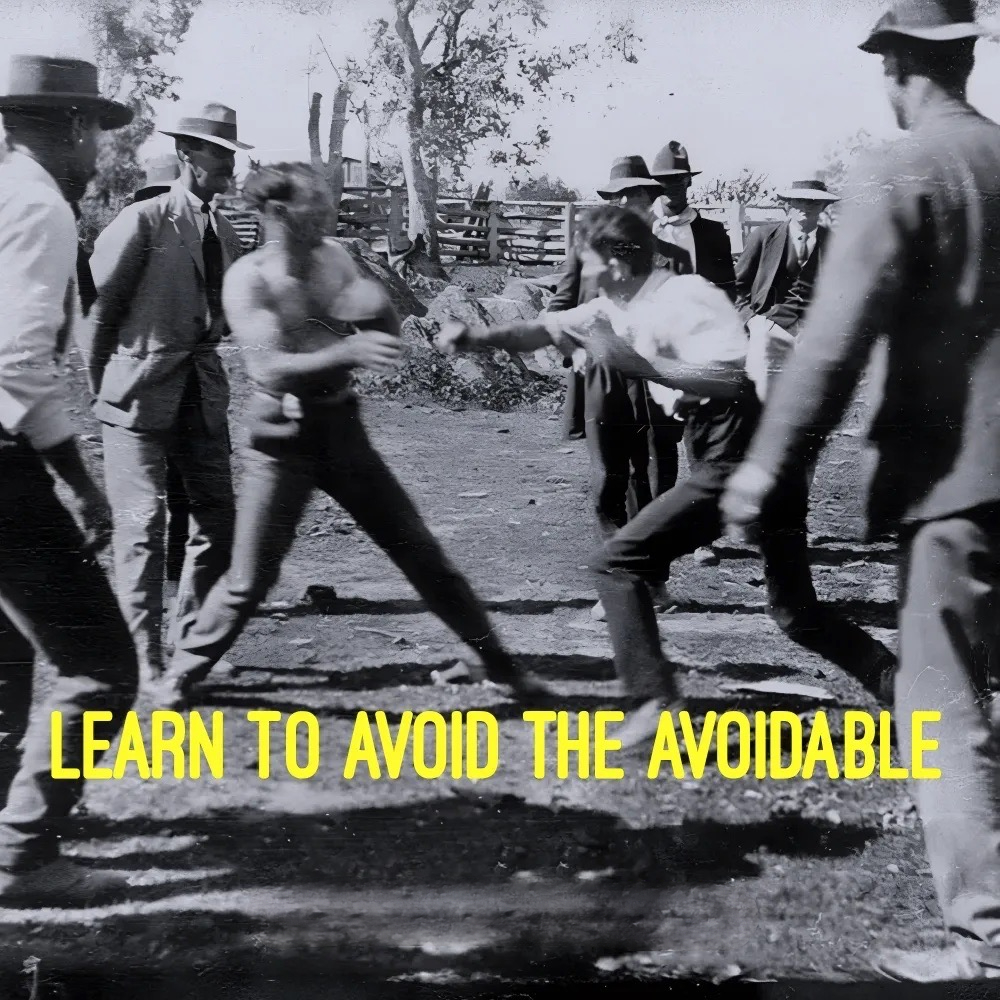
When you look at this picture, which guy needs self-defense?

If you found yourself in the above situation, what would you do?

I look forward to your thoughts and further discussion.

–Chris Ranck-Buhr
   TFT Master Instructor

Bookmark and Share

“Socially Horrifying”

June 9, 2011 by Chris Ranck-Buhr

This recommendation comes to us from Gregory, a TFT Cadre Instructor living in Colombia:

“Here’s a great article on how David beats Goliath.

There’s a phrase that crops up about two thirds of the way through, that he must do what is ‘socially horrifying.’ It also talks about effort over skill, about doing what you’re not supposed to do. The relevance for our common interest is, I think, “substantial.”

The article is on the long side, but well worth the read. It gets right to the heart of why we train the way we train: I don’t want you to defend yourself, or play by the rules (even the assumed, unwritten ones), or go skill-to-skill or strength-to-strength.

Because that’s how you lose.

I’d love to hear your thoughts!

–Chris Ranck-Buhr
   TFT Master Instructor

Bookmark and Share

Fighting the Urge to Square Off in Lethal Force Self-Defense

April 10, 2011 by Chris Ranck-Buhr

One of the peculiar things I’ve noticed about people in all the years I’ve been training is the desire to have a static “start” position before getting to work.

It’s always the same — standing, facing one another just out of arms reach. No one’s ready to go until everybody toes that line and hits that zero point to reset the proceedings for another turn.

It’s almost as if they’re listening to an announcer only they can hear, “on your mark,” (everybody gets up), “get set,” (they turn and face each other), “go!”

The fact is they are listening to a distant voice — the one that thinks this is a social interaction, a fight… and everyone knows you square off to fight.

The only problem is it’s completely artificial and has the sad consequence of forcing you to try to stick to the script (“I get up, we face off, and then go,”) while he’s ad libbing – tackling you from behind, kicking you while you’re down, starting in before you’re ready, etc.

The belief is that it won’t matter — you’ll figure it out on the fly, highly motivated by the knowledge that this is really ‘it.’ That squaring off in practice won’t matter.

But we all know you’ll perform as you practice, and if you only start once you get up and square off on the mats you’ll struggle to do so while he beats you back down on the concrete.

read this entry »

Bookmark and Share

Lethal Force Self-Defense: Why the Lethal Part?

March 23, 2011 by Chris Ranck-Buhr

Much is made of the fact that we teach bare-handed killing — it’s the sensational tag line for media reports on what we do, and it’s the first thing people notice when they see us training. (Not so much with the knife and stick, as lethality with weapons is expected. After all, that’s what they’re for, right?)

Just the other day one of the instructors at the TFT San Diego Center lamented about the difficulty in talking to people about what he does. The conversation just stops dead at the killing part.

So why do we do it?

The primary reason is to clearly draw the line between what should be expected to kill the man, and what, in general, won’t.

Debilitating injury is the only thing that means anything in violence, so we train to smash, crush, rupture, break, dislocate or otherwise ruin parts of the body that have important jobs to do. He can’t walk on a broken ankle, for example. If that piece of anatomy is required to sustain life, then he begins to die when it ceases to function.

The brain bleed, crushed throat, broken neck, lacerated liver, ruptured spleen, etc., can all lead to death.

We show you how to do these things so you know where that line is.

read this entry »

Bookmark and Share

Lethal Self-Defense vs. MMA

February 21, 2011 by Chris Ranck-Buhr

R. R. writes:

“My concern is facing someone who is trained in MMA or some reality-based system.

“I’ve followed you since the beginning — and it all makes so much sense — but I still wonder ‘Can I do what these guys [TFT] are saying to do?’

“I have a family member who’s been training for almost three years in MMA and he’s the kind of guy who shouldn’t be allowed to train in any system. I’ve read your book and I need some additional insights just in case I have to fight with this family member.  He thinks he’s the toughest guy around.

“I’ve already had an altercation with a MMA guy and even though he didn’t beat me up he still got an ankle lock while I was standing and it bothers me to this day. I hope you can help me out with what to do and go into some detail about facing an experienced martial artist or athlete involved in MMA.”

Chris Ranck-Buhr answers:

You bring up a number of issues; I’ll do what I can to address them all.

Facing Someone Who’s Trained

You can compete, or you can destroy.  To compete, all you have to do is go strength-to-strength, skill-to-skill and will-to-will with someone.  If you’re stronger, more skilled and want it more than him, you’ll win.  If not… he’ll get you on one or more of those.

read this entry »

Bookmark and Share

Self-Defense Is a Sham: Further Thoughts

January 11, 2011 by Chris Ranck-Buhr

self defenseSelf-defense means many things:

  • It is the moral imperative we use to draw a line between predatory and “civilized” use of force. “I will only fire in self-defense.”
  • It is the legal rule we use to judge whether or not that use of force is a crime. “The defendant claims to have acted in self-defense.”
  • It’s a catchall term used to describe physical training for such activities. “I’m taking a self-defense class.”
  • It can also refer to the unarmed techniques learned there. “If someone comes after me I’ll use self-defense on him.”

It means many things — and this vague imprecision is exactly why it is useless for our needs in training to do violence by hand.

The moral imperative and the legal rule are fine for what they do — one informs the decision process before the fact and the other helps society figure out how it feels about it after the fact — it is the carrying over of the term to describe physical training and technique that is harmful.

As was pointed out in the comments to the previous post, words mean things. A single word can connote entire constellations of meaning, in varying shades and intensities.

read this entry »

Bookmark and Share

Self-Defense Is a Sham

January 7, 2011 by Chris Ranck-Buhr

When you think of “self-defense” or “self-protection”, what do you see?

I see nothing.

Okay, maybe that’s a little too harsh, too fast.

If I try really hard to cut through the ambiguous fog of those phrases, I can almost see — at best — someone getting attacked, desperately trying to get away, maybe getting backed into a corner. Flailing like a terrified animal.

At worst I see someone curled up in a ball on the ground.

That’s what “self-defense” means to me.  And that’s why I won’t teach, practice or do it.

I’m only ever interested in hurting people.

The term “self-defense” has no operational value. It does not paint a picture of me doing anything of consequence — it suggests passivity, being acted upon by someone else, moving second and hoping for the best. Rather than getting anything done.

read this entry »

Bookmark and Share

Is Lethal-Force Self-Defense Useful in Your Everyday Life?

October 9, 2010 by Chris Ranck-Buhr

I would hope not.

As we say at our courses, we sincerely hope you never have to use what we’re teaching.

But, like a fire extinguisher or handgun, when you need it, nothing else will do. You don’t buy one looking forward to the opportunity to use it — it will very probably be a Very Bad Day should you need one — but rather for the peace of mind that preparedness brings.

Back to the original question — can lethal-force self-defense training be useful in daily life? Or is it, like the fire extinguisher and handgun, essentially useless outside of extremely rare cases? Let’s take a look at the opinion of one of our clients.

read this entry »

Bookmark and Share

In Lethal Force Self-Defense, Context Is Everything

October 5, 2010 by Chris Ranck-Buhr

Much is made in the media over our brutally direct and stripped-of-sugar-coating training for life-or-death self-defense. Tim’s experiences in London last year and our recent coverage by a CBS affiliate focused almost entirely on the shock value of “killing with your bare hands” and the obvious moral and legal distance between stomping a downed man and what constitutes both a fair fight and “reasonable force.”

The chief problem here is a disconnect between what we’re teaching and the civilized person’s understanding of what’s acceptable to do in a “fight.”

I’ve illustrated this ridiculous gap in the past by writing about how you can append any problem you think may result in or require violence with “…so I gouged out his eye.” Let’s go straight for the bone on this one and change it out for “…so I broke his neck.”

  • “A guy gave me a dirty look… so I broke his neck.”
  • “A guy called me names… so I broke his neck.”
  • “A guy wanted to ‘kick my ass’… so I broke his neck.”
  • “After emptying the clip into the crowd he started to reload… so I broke his neck.”

Only one of those comes close to making any sense at all, and yet it’s the first three nonsensical constructions that the media focus on. Why?

read this entry »

Bookmark and Share

Training in TFT: Part 2 – Are You Held To A Higher Standard

September 10, 2010 by Tim Larkin

There have been some great comments on Part 1 of this post regarding the video footage various broadcast television stations are using in local self defense news stories.

My thanks especially to attorneys Zeljko Vukman (who’s had training similar to TFT while in Special Forces in the former Yugoslavia) and Ron Bear (California). If you haven’t read their comments you can find them here.

Thanks also to all of you that left your comments directly on the broadcast stations’ websites. They have certainly heard your voice.

The folks who produced the original video the broadcast stations are using are now forwarding attorney/TFT instructor Matthew Suitor’s comments (you can see Matt’s response here).

They’re also including an updated script for the stations to use. However, with the university professor’s comments already on video we’ll have to see if it helps much.

Finally, I wanted to touch on the 3 questions I left you with…

read this entry »

Bookmark and Share
« old entrys
Subscribe by Email

Get notified of new blog posts.
We'll send a reminder right to your inbox!


Enter your email address:

FREE Book Preview... "How to Survive the Most Critical 5 Seconds of Your Life"

srreport

Get your FREE Preview of Tim Larkin's book, "How to Survive the Most Critical 5 Seconds of Your Life." You get the first 7 Chapters (a full 51 pages) of the book, and it will give you a detailed understanding of what is required to survive life or death violence.

You also get Tim's award-winning, 12-part e-course, "Secrets For Staying Alive When Rules Don't Apply."
In addition, you'll be entered for a chance to attend a 2-day, $1,997 live training seminar -- FREE. There's no obligation.

I certify that I am at least 18 years old